 Skip-the-line available
 Pernštejn Castle or Bouzov Castle?
Both are Moravian castles with fairy-tale silhouettes, but one is genuinely medieval and the other is a turn-of-the-century romantic rebuild.
Pernštejn and Bouzov are often mentioned in the same breath as Moravia's two great fairy-tale castles, but the resemblance is mostly silhouette. Here's how they actually differ in age, authenticity and setting, and how to choose between them if a single trip can only stretch to one.
Two castles, two centuries apart in spirit
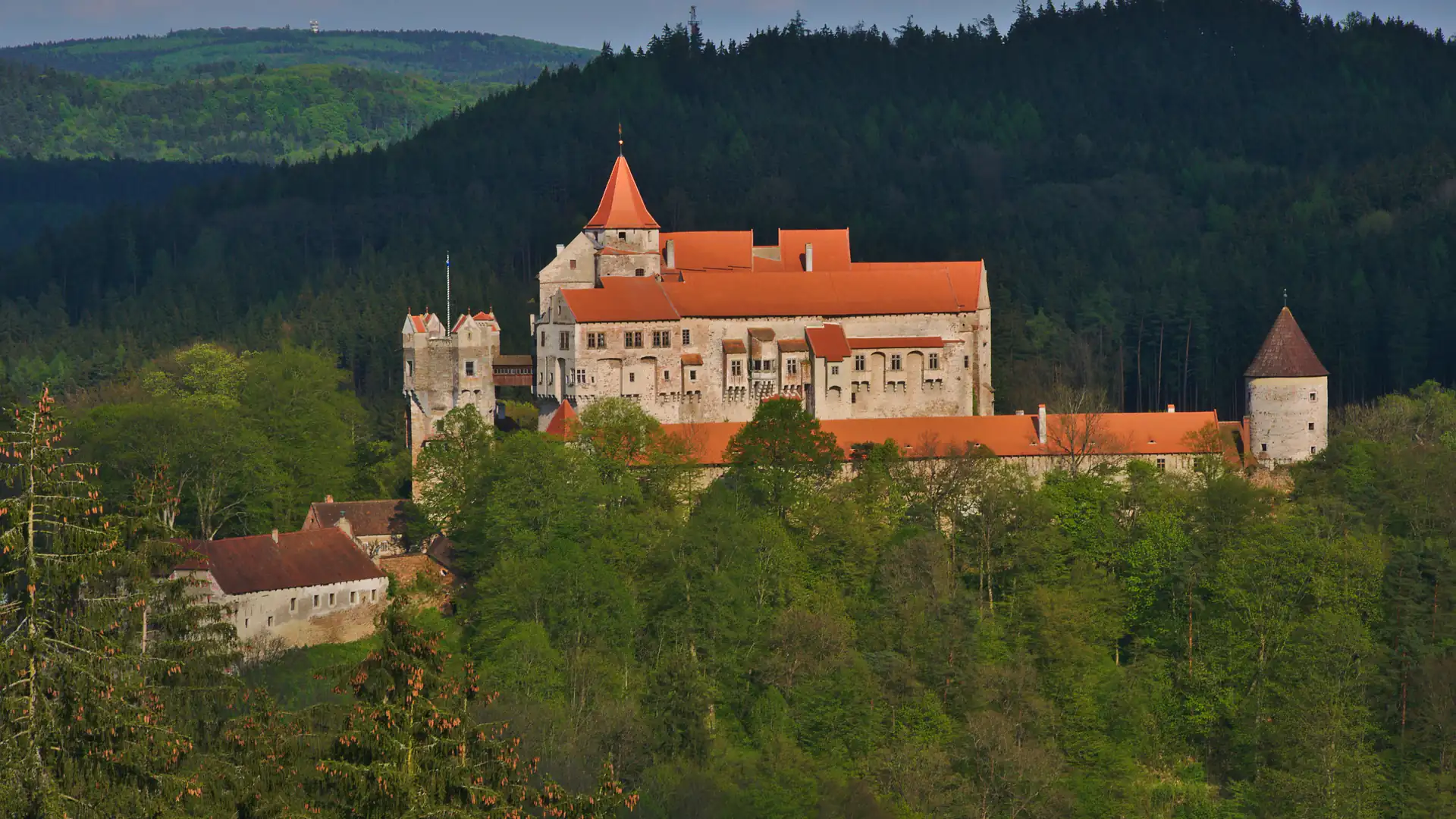
Pernštejn Castle's Gothic core dates from the late 13th century, rebuilt into its present Renaissance form by the Pernštejn family in the 15th and 16th centuries and left largely untouched since — what you walk through today is, in essence, the castle as it stood five hundred years ago, weathered but unaltered in its fundamental structure and layout.
Bouzov Castle has medieval origins too, first recorded in 1317, but what visitors see today is overwhelmingly a romantic reimagining rather than a medieval survival in the way Pernštejn is. Between 1895 and 1910, Archduke Eugen of Austria, Grand Master of the Teutonic Order, commissioned architect Georg von Hauberrisser to remake Bouzov as a fairy-tale neo-Gothic castle, complete with modern conveniences like running water and central heating tucked behind its picturesque towers.
Both castles are genuinely old sites with genuinely medieval foundations underneath everything visible today. The difference is what happened to each of them afterward: Pernštejn kept building on top of what came before without erasing it, while Bouzov was substantially reinvented at the turn of the 20th century to fit a very particular romantic idea of what a knight's castle should look like to a modern eye.
It's worth saying plainly that this isn't a case of one castle being "real" and the other "fake" — both have genuine medieval roots. It's a question of how much of what you actually see and walk through on the day dates from the medieval and Renaissance period versus a later, deliberate reconstruction.
That distinction rarely comes up unprompted in either castle's own presentation of itself, which is exactly why it's worth knowing before you go — it changes what you're actually looking at, room by room, even when the overall silhouette looks similar in a photograph.
It also explains why guidebooks and travel articles group the two together so readily: both photograph beautifully from a distance, both sit on wooded high ground, and both carry the word "castle" with the same fairy-tale weight in English, even though the buildings behind that word arrived at their present form by very different routes.
What's original at Pernštejn vs rebuilt at Bouzov
This is the real distinction between the two, and the one worth understanding before you choose which to prioritise on a shorter trip. Pernštejn's Barbican, Gothic corridors, Tower of Four Seasons and Renaissance Knights' Hall are the actual structures the Pernštejn family built and lived in centuries ago — a genuinely unaltered medieval-Renaissance fortress, not a reconstruction built to evoke one.
Bouzov's eight-storey watchtower, horseshoe layout and dry moat, by contrast, are largely the product of that early-20th-century rebuild — a deliberately romantic vision of what a knightly castle should look like, built by a modern architect working for a modern client, rather than a survival from the Middle Ages in the way Pernštejn's rooms genuinely are.
Neither approach is dishonest — Bouzov doesn't pretend to be something it isn't, and its neo-Gothic rebuild is a legitimate and well-executed piece of architecture in its own right, admired for what it is rather than mistaken for something older. But if authenticity of fabric matters to you specifically as a traveller, the two castles are answering genuinely different questions.
A useful way to think about it: visiting Pernštejn is like reading an original historical document; visiting Bouzov is like reading a very well-researched historical novel set in the same period. Both can be worthwhile, but they aren't offering the same thing.
Neither castle hides this distinction from anyone who asks, but it rarely comes up unless a visitor specifically wants to know — which is exactly the kind of honest disclosure worth getting before you decide where to spend a limited day in Moravia.
Inside: knights' hall against knights' hall
Both castles have a knights' hall, and both are worth seeing, but they tell different stories about the buildings around them. Pernštejn's Knights' Hall carries genuine Renaissance stuccowork and frescoes commissioned by the family that actually held power here — decoration built by and for the Pernštejns themselves, in the century they built it, for their own use rather than for later visitors.
Bouzov's knights' hall preserves earlier Gothic vaulting within a building substantially reshaped around it in the 1900s, so the hall itself sits inside a largely new architectural envelope even where individual older elements genuinely survive within it from the medieval structure.
If what draws you to a castle is standing in rooms largely unchanged since the people who built them actually lived there, Pernštejn is the stronger choice by a clear margin. If you're drawn to the romantic, picture-book idea of a castle — turrets, a moat, a drawbridge, all deliberately composed for maximum fairy-tale effect — Bouzov delivers that more directly, because that was precisely the brief its architect was given.
Visitors who've done both tend to describe Pernštejn as the more atmospheric of the two, in the sense of feeling genuinely old, and Bouzov as the more immediately picturesque — a distinction that says more about what each castle is trying to be than which one is objectively "better."
Neither hall is a disappointment in person; the difference only really registers once you know to look for it, which is the whole point of setting the two side by side before you commit a day to either one.
Distance and setting
Pernštejn sits about 40 km northwest of Brno, above the village of Nedvědice on the edge of the Bohemian-Moravian Highlands. Bouzov lies roughly 27 km northwest of Olomouc, in the Olomouc Region — a different city, a different regional base, and not especially close to Pernštejn itself in either driving time or geography.
The two castles are not on the same touring route in any natural sense; visiting both on the same day usually means a longer, more ambitious drive across a good stretch of Moravia rather than a simple detour from one to the other on the way through.
Most travellers pair Pernštejn with a Brno-based trip and Bouzov with an Olomouc-based one, rather than treating them as a single day's itinerary, unless the wider trip is already built around a longer self-drive loop through the region that naturally passes near both.
Brno and Olomouc are themselves roughly an hour apart by road or rail, which gives a rough sense of the detour involved in visiting both castles on a single trip rather than choosing one to anchor each city stay.
For travellers moving through Moravia in one direction — say, Vienna to Prague, or Bratislava to Prague — the two castles can sometimes be worked into the route as successive stops rather than a dedicated round trip from a single base.
It's worth building in a buffer either way: both castles sit at the end of country roads rather than motorways, and the final approach on foot at each site adds time beyond what a simple driving-time estimate between the two towns would suggest.
Which one to choose
If you only have time for one castle near Brno and want the authentic article — original Gothic and Renaissance fabric, a castle that was genuinely never taken by force across more than seven centuries — Pernštejn is the clearer choice, and it's also the closer of the two to Brno for most travellers' itineraries.
If your trip is centred on Olomouc instead, or you specifically want the postcard-perfect, turreted romantic castle look for its own sake, Bouzov earns its reputation on its own terms and shouldn't be dismissed just because its towers are younger than they first appear to a visitor.
Travellers doing a longer Moravian loop, with more than a couple of days to spend outside Brno and Olomouc, often manage to fit in both — and given how different the two experiences actually are once you're inside the walls, the comparison is genuinely worth making in person rather than settling for only one and wondering about the other.
For a first-time visitor to Moravia with only one castle day to spare, the practical answer is usually whichever city you're already based in — Pernštejn from Brno, Bouzov from Olomouc — rather than adding a long cross-country drive purely to see the "better" of the two.
Whichever you choose first, knowing the real difference between the two — original fabric against romantic rebuild — means you'll go in with accurate expectations rather than assuming the two are simply interchangeable versions of the same visit.
Frequently asked
Is Pernštejn Castle or Bouzov Castle more historic?
Pernštejn's Gothic and Renaissance interiors are largely original, dating from the 13th to 16th centuries. Bouzov's medieval origins go back to 1317, but its current appearance is mostly a romantic rebuild from 1895–1910.
Which castle is closer to Brno?
Pernštejn, at about 40 km northwest of Brno. Bouzov is roughly 27 km northwest of Olomouc, a separate city further east.
Can I visit both castles in one day?
It's possible with a full day and a car, since they're not close to each other, but most visitors base a Pernštejn visit around Brno and a Bouzov visit around Olomouc rather than combining them.
Which castle is better for fairy-tale photos?
Bouzov's neo-Gothic towers were purpose-built for exactly that picturesque effect. Pernštejn's silhouette is dramatic in its own right and has drawn film productions including Van Helsing, but its interiors reward visitors more interested in authentic history than romantic styling.