 Skip-the-line available
 The history of Pernštejn Castle
Seven centuries, one castle that was never taken by force, and a handful of families whose fortunes rose and fell around it.
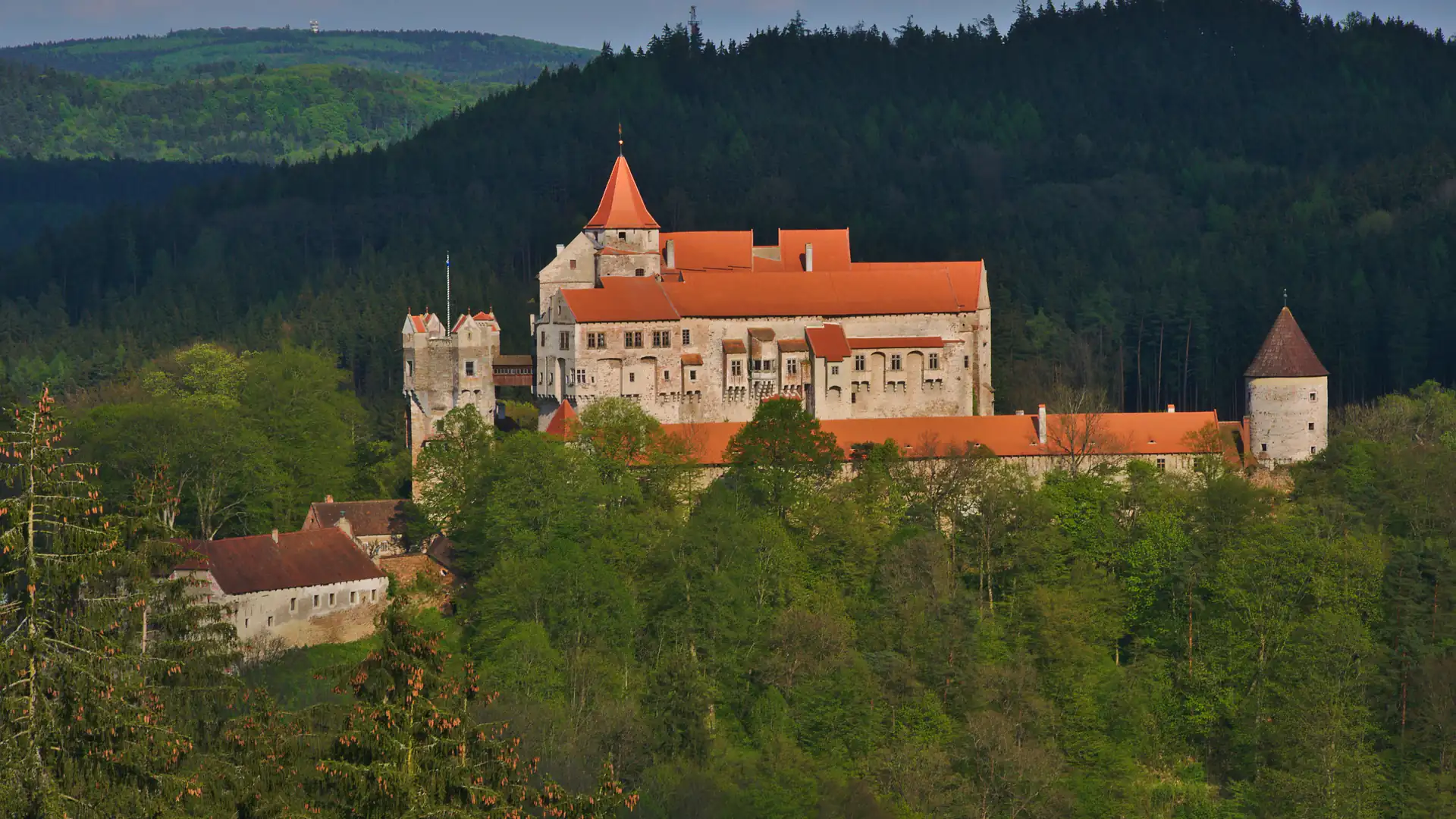
Pernštejn Castle's history runs from a minor 13th-century border fort to the seat of one of Bohemia's wealthiest families, through a war that failed to take it, and on to state ownership today. Here's the story in order, drawn from the castle's own published history and independent sources on the Pernštejn family.
The Lords of Medlov, 1285
The Lords of Medlov founded Pernštejn Castle probably between 1270 and 1285, on a rock spur chosen for its natural defensibility above the Svratka valley — a site that offered a clear view of the approaches in every direction and required any attacker to commit to a single narrow route to reach the gate rather than surrounding it freely.
The first written record of a lord "of Pernštejn" — rather than "of Medlov" — dates to 1285, when a document names one Štěpán of Pernštejn and Medlov, marking the moment the family began to be identified with the castle's name rather than the older one they had carried before.
That name would go on to mean a great deal in Bohemian and Moravian history; the family that started as minor regional lords on this rock became, within two centuries, one of the most powerful noble houses in the kingdom, and the castle grew alongside their fortunes rather than staying fixed at its modest 13th-century scale.
Little of that original late-13th-century fortress survives unaltered on its own — later Gothic and Renaissance building work absorbed and expanded most of it — but the site's chosen position, the rock itself, has never changed, and it remains the reason the castle could never be simply surrounded and starved out.
It's worth remembering how modest the beginning was: a regional lord's fort on a defensible rock, one of many built across Moravia in the same restless decades, with nothing at the time to suggest it would still be standing, largely intact, more than seven hundred years later.
Most of the family's neighbouring 13th-century strongholds in the region have long since fallen into ruin, been absorbed into later towns, or vanished entirely — which is exactly what makes Pernštejn's continuous, legible history from 1285 onward genuinely unusual rather than merely old.
William II and the Renaissance rebuilding
The Pernštejn family's rise reached its peak under William II of Pernštejn in the late 15th and early 16th centuries, by which point the family was reckoned the wealthiest and most powerful noble house in the Kingdom of Bohemia — a position built on land, offices and royal favour accumulated over generations rather than a single stroke of fortune or a single advantageous marriage.
That fortune rebuilt the castle rather than replaced it. Gothic walls, towers and corridors stayed in place while Renaissance oriel windows, vaulted ceilings and the great Knights' Hall were threaded through and around them, work that continued for decades and drew on the finest craftsmanship the family's wealth could command from across the region.
It's the reason Pernštejn Castle today reads as two eras worn one inside the other, rather than a single style throughout: walk from the Gothic corridors into the Knights' Hall and the transition from defensive fortress to Renaissance residence happens within a few steps, exactly as William II's masons intended visitors to see it.
This was also the period in which the castle's decorative rooms — the ones visitors spend the most time in today — took their essential shape; almost everything added after William II's era built on top of this Renaissance foundation rather than superseding it.
The Pernštejns' wealth at this point wasn't confined to Pernštejn Castle alone — the family held estates and offices across the Bohemian crown lands — but this rock remained their ancestral seat, and it received the most sustained architectural attention of anything they owned.
1645: the siege that failed
During the Thirty Years' War, a Swedish army campaigning through Moravia turned its cannon on Pernštejn Castle in 1645, part of a wider Swedish push through the region that saw many Moravian towns and fortifications fall or surrender in the same campaigning season. It was the one serious attempt in the castle's history to take it by force — and it failed comprehensively.
The barbican's three-metre-thick walls, built generations earlier for exactly this kind of assault, held the attackers off, and the high, exposed position of the castle rock made a prolonged siege genuinely difficult to sustain for an army that needed to keep moving through the region. Scorch marks on the upper towers, still visible today, are the clearest physical evidence of that siege and the fighting it involved.
Across more than seven centuries of Bohemian and Moravian turmoil — wars, sieges, and the fall of countless neighbouring strongholds throughout that long period — the 1645 Swedish siege remains the only recorded attempt to capture Pernštejn Castle outright, and the only one anyone with the means to try it actually attempted.
It's a detail that surprises many visitors once they learn it: a castle this old, in a region fought over as often as Moravia was across the medieval and early modern periods, simply has no other siege on its record to compare it to.
The Thirty Years' War was especially hard on Moravia's castles and towns generally, which makes Pernštejn's survival even more notable in context — it wasn't spared because the fighting passed it by, but because it was actually tested and held.
From the Pernštejns to the Mitrovskýs
The Pernštejn family sold the castle in 1596, ending two centuries of their ownership, in what appears to have been the ordinary drift of a great family's fortunes and priorities rather than any single crisis or disaster forcing their hand. Ownership then passed to the Stockhammer family and later the Schröfl von Mannsperg family, each holding the estate for a period before it changed hands again.
The Mitrovskýs bought their way into Pernštejn Castle in 1818 and completed their purchase of the whole estate by 1828, becoming its longest-serving owners after the Pernštejns themselves across more than a century of continuous family ownership. They held it through the 19th century, adding Romantic-era touches to its interiors that sit alongside the older Gothic and Renaissance work throughout.
It was under the Mitrovskýs that the vaulted Renaissance hall now known as the library took on its current role, filled with the books and collections a 19th-century noble family built its cultural standing on, and it's their layer of the castle's history that visitors see most clearly in its more domestic, lived-in rooms.
The Mitrovský era also saw the first serious damage the castle had suffered in centuries when a fire in 1886 struck the Tower of Four Seasons — a reminder that fire, not siege, was always the more realistic threat to a building like this, whatever its defensive reputation against human attackers.
Ownership through this middle stretch of the castle's history — Stockhammer, Schröfl von Mannsperg, then Mitrovský — is less dramatic than the Pernštejn centuries or the 1645 siege, but it's this period, and particularly the Mitrovskýs, that shaped the more domestic rooms visitors see toward the end of the Route I tour today.
1945 to today
In 1945, Mitrovský ownership of Pernštejn Castle ended and the property passed into Czechoslovak state hands, part of the wider transfer of large estates that followed the end of the Second World War across the region. It was not the only setback the castle had absorbed by that point: beyond the 1886 tower fire, a later fire in 2005 affected the granary, which was subsequently rebuilt by 2009.
Through all of it, the core Gothic and Renaissance structure that the Pernštejns and their successors built survived intact — a continuity across ownership changes, wars and accidental fires that few castles of this scale in Central Europe can genuinely claim, whatever their individual reputations for age or grandeur.
Today Pernštejn Castle is a state-administered national cultural monument, protected since 1995, open to visitors on the guided Route I tour that traces its full arc from Gothic fortress to 19th-century family home, in the same rooms shaped by seven centuries of the families who called it home in turn.
That seven-century thread — Medlov to Pernštejn to Stockhammer to Mitrovský to the Czech state — is unusually easy to follow for a visitor precisely because so little of the physical fabric was ever torn down and started over; each family's contribution is still legible against the last.
Walking Route I with this sequence in mind turns the tour into something closer to reading a timeline than simply admiring a collection of old rooms — each stage of the castle's ownership left something you can still point to today.
Few castles anywhere let a visitor trace seven straight centuries of ownership this cleanly, room by room, without a single serious gap or unexplained rebuild — and that continuity, as much as any single room, is what the history of Pernštejn Castle is really about.
Frequently asked
How old is Pernštejn Castle?
The castle was founded probably between 1270 and 1285, with the first written record of a lord "of Pernštejn" dating to 1285 — making it well over 700 years old.
Was Pernštejn Castle ever captured?
No. Despite a determined Swedish siege in 1645 during the Thirty Years' War, Pernštejn Castle was never taken by force in its entire recorded history.
Who was William II of Pernštejn?
The head of the family during its 15th–16th century peak, by whose time the Pernštejns were reckoned the wealthiest and most powerful noble house in the Kingdom of Bohemia. He oversaw the castle's Renaissance rebuilding.
Who owns Pernštejn Castle now?
The Czech state, which has administered it since 1945; it has been protected as a national cultural monument since 1995.
What happened to the Mitrovský family?
The Mitrovskýs owned Pernštejn Castle from 1818 until 1945, when their ownership ended and the castle passed into state hands at the close of the Second World War.