 Skip-the-line available
 Getting to Pernštejn Castle from Brno
About 40 km separates Brno from Pernštejn, but the castle's hilltop position means the last stretch of any route is always on foot.
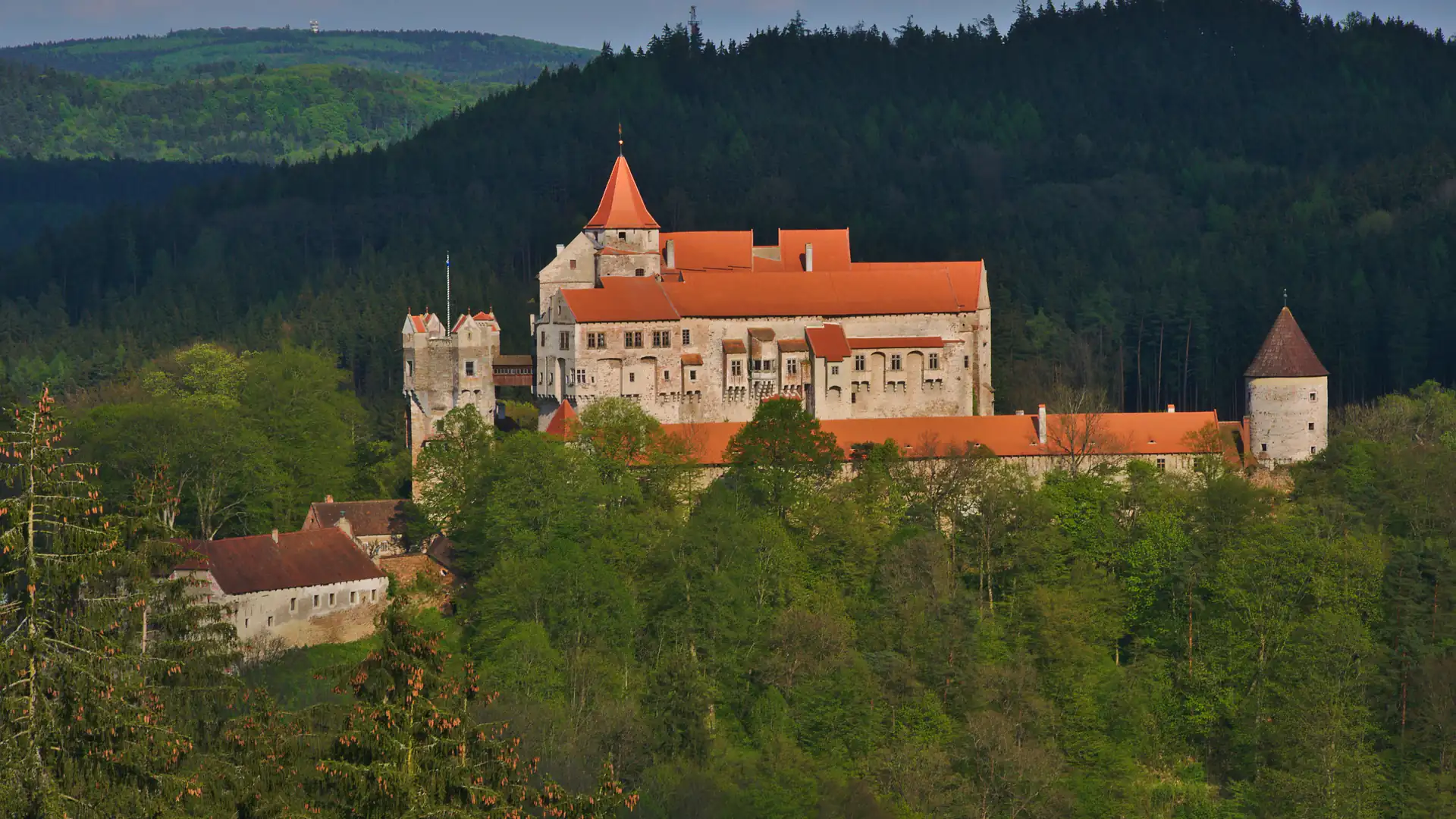
Pernštejn Castle sits above the village of Nedvědice, roughly 40 km northwest of Brno, in wooded country on the edge of the Bohemian-Moravian Highlands. Here's how travellers without a rental car — and those with one — actually make the trip, and what the final stretch on foot is really like once you arrive.
How far it actually is
Pernštejn Castle stands about 40 km northwest of Brno, above the village of Nedvědice, close to where South Moravia gives way to the Bohemian-Moravian Highlands. It's an easy half-day trip from the city in distance terms, though the winding country roads through this hillier part of Moravia mean the journey takes rather longer than the straight-line distance alone would suggest to anyone glancing at a map.
Most visitors treat Pernštejn as a half-day or full-day excursion from Brno, often combined with the wider Highlands countryside — the Vír reservoir, or smaller sights further along the Svratka valley — rather than rushed through as a quick stop on the way to somewhere else entirely on a tighter schedule.
There's no shortcut that avoids the countryside drive or train ride; Pernštejn sits well outside Brno's suburbs, in a genuinely rural stretch of South Moravia, which is a large part of its appeal as a day trip away from the city rather than a detriment to visiting it.
Travellers coming from further afield — Vienna, Prague, or across the border from Slovakia or Austria — should treat Brno as the practical staging point for a Pernštejn visit rather than attempting the trip directly from a more distant base in a single day.
Brno itself is well connected by rail and road to those larger cities, which is exactly why it functions as the natural jumping-off point for this whole corner of South Moravia, Pernštejn included.
Treat the 40 km figure as a guide to distance rather than to driving time: on the smaller roads through the Highlands foothills, allow closer to an hour each way once you're off Brno's ring road, longer if you're travelling behind slower agricultural traffic on a summer weekend.
By car
Driving is the most flexible option, and the route from Brno runs northwest through rolling farmland and forest towards Nedvědice, following minor roads for the final stretch rather than a motorway all the way to the gate. A car park sits below the castle rock, from which the final approach continues on foot — there's no vehicle access up to the gate itself, whatever the size or category of your vehicle or how close you'd like to get.
A car also makes it straightforward to combine Pernštejn with nearby sights such as the Vír reservoir or the smaller castle at Kunštát, since public transport between the villages of the Bohemian-Moravian Highlands is limited outside the main rail and bus routes, and a self-driven day can string several stops together that would otherwise mean separate, disconnected trips.
Parking itself is not usually the constraint on a summer visit — the constraint is the guided tour's 35-person cap — but arriving with time to spare before your booked departure matters more than usual on a day when the car park itself is busy and finding a space takes longer than expected.
Road signage to Pernštejn is generally clear once you're off the main routes and into the Nedvědice area, but a modern satnav or offline map is still worth having, since the final approach roads are narrow country lanes rather than well-lit main roads, especially useful if you're arriving for an early morning departure.
Fuel and services are best sorted before leaving Brno or a larger town along the way; the immediate area around the castle is small and rural, built around the visit itself rather than around passing motorists' other needs.
By train and bus
Regional trains connect Brno with Nedvědice, the village directly below the castle, on a line that winds up through the Svratka valley rather than travelling in a straight line between the two points. From Nedvědice station, the castle is reached by a signposted walk up through the village and then the woods to the car park and gate — there is no shuttle bus that runs directly to the castle entrance itself.
It's a workable option without a car, and a scenic one, since the valley the train follows is itself part of the Highlands landscape rather than merely a way of passing through it to reach the destination. Journey times run longer than driving, and services are less frequent than on Brno's main commuter lines, so it's worth checking the timetable for your specific travel date before you set out rather than assuming a train runs roughly every hour as they do on busier routes.
Combining the train with the onward walk from the station adds a further stretch to the already steep climb from the car park, so travellers relying on public transport should build in noticeably more time overall than those arriving by car, particularly if connecting from a train elsewhere in the network.
Regional buses also serve some of the villages around Nedvědice, though schedules tend to be sparser than the train and better suited to travellers already staying somewhere nearby than to a single day trip planned entirely around bus connections from Brno.
For most visitors without a car, the train to Nedvědice remains the more reliable backbone of the journey, with the walk from the station simply treated as the final, unavoidable leg of getting to the castle rather than an inconvenience to route around.
The walk from the car park
However you arrive, the last stage to Pernštejn Castle is the same: a walk up from the car park below the rock, taking roughly 10 to 25 minutes depending on your pace, your fitness, and how many stops you make to look back at the view opening up behind you as you climb. It's a genuinely steep climb through woodland, not a gentle stroll on level paths through open parkland.
Comfortable, sturdy shoes make a real difference here, and it's worth building the climb into your overall timing rather than arriving at the car park with only minutes to spare before a booked tour departure — being late for a capped, timed guided tour isn't something the castle can easily accommodate once a group has already set off with its guide.
The climb has its own reward: the barbican doesn't come into view until you're most of the way up, so the approach on foot is part of how the castle is meant to be experienced, rather than simply an obstacle standing between the car park and the gate you'd rather skip if you could.
Families travelling with young children or anyone with limited mobility should factor the climb into their plans specifically; there's no alternative route to the top, and the path, while maintained, follows the natural contour of the rock rather than a graded, accessible gradient.
A pram or pushchair is generally impractical on this path; travellers with young children tend to do better carrying them for the final stretch than attempting to wheel them the whole way up from the car park.
Combining it with the wider Highlands
Because the drive out from Brno passes through genuinely rural South Moravia and the edge of the Bohemian-Moravian Highlands, many visitors turn the trip into more than a single stop — pairing Pernštejn with the Vír dam and reservoir valley, or the smaller Gothic-Renaissance castle at Kunštát, on the same day, using Pernštejn as the anchor point around which the rest of the day is planned.
If your time is tighter, Pernštejn alone is still a satisfying half-day from Brno once you account for the drive or train journey, the uphill walk, and the roughly 80-minute guided tour itself — there's no need to force in a second stop if the schedule doesn't comfortably allow for one without rushing.
Whichever way you build the day, allow more time than you think the map distance implies. Between the country roads, the walk up, and a guided tour that runs to its own fixed length rather than your own pace, a Pernštejn visit from Brno rewards a relaxed half-day rather than a tightly scheduled one squeezed between other commitments.
Travellers basing themselves in Brno for several days often find Pernštejn works best as a dedicated excursion day on its own, leaving the city itself — and its own sights, like Špilberk Castle — for a separate day rather than trying to combine the two in a single, overly ambitious itinerary.
Whichever combination you settle on, the drive back into Brno at the end of the day is straightforward and requires no special planning, which makes Pernštejn an easy trip to bookend an evening back in the city.
It's a trip that rewards not over-planning it: once the castle booking itself is fixed, the rest of the day can flex around weather, energy levels and whatever else catches your interest along the way, rather than following a rigid schedule from door to door.
Frequently asked
How far is Pernštejn Castle from Brno?
About 40 km northwest of Brno, near the village of Nedvědice on the edge of the Bohemian-Moravian Highlands.
Can I reach Pernštejn Castle by train?
Yes — regional trains run from Brno to Nedvědice station, followed by a signposted walk up through the village and woods to the castle car park and gate.
Is there parking at the castle?
Yes, a car park sits below the castle rock. There's no vehicle access beyond it — the final approach to the gate is on foot for every visitor.
How steep is the walk up to the castle?
Genuinely steep. From the car park it takes roughly 10 to 25 minutes on foot uphill through woodland, so wear shoes you can comfortably climb in.